How to use
How to use this site
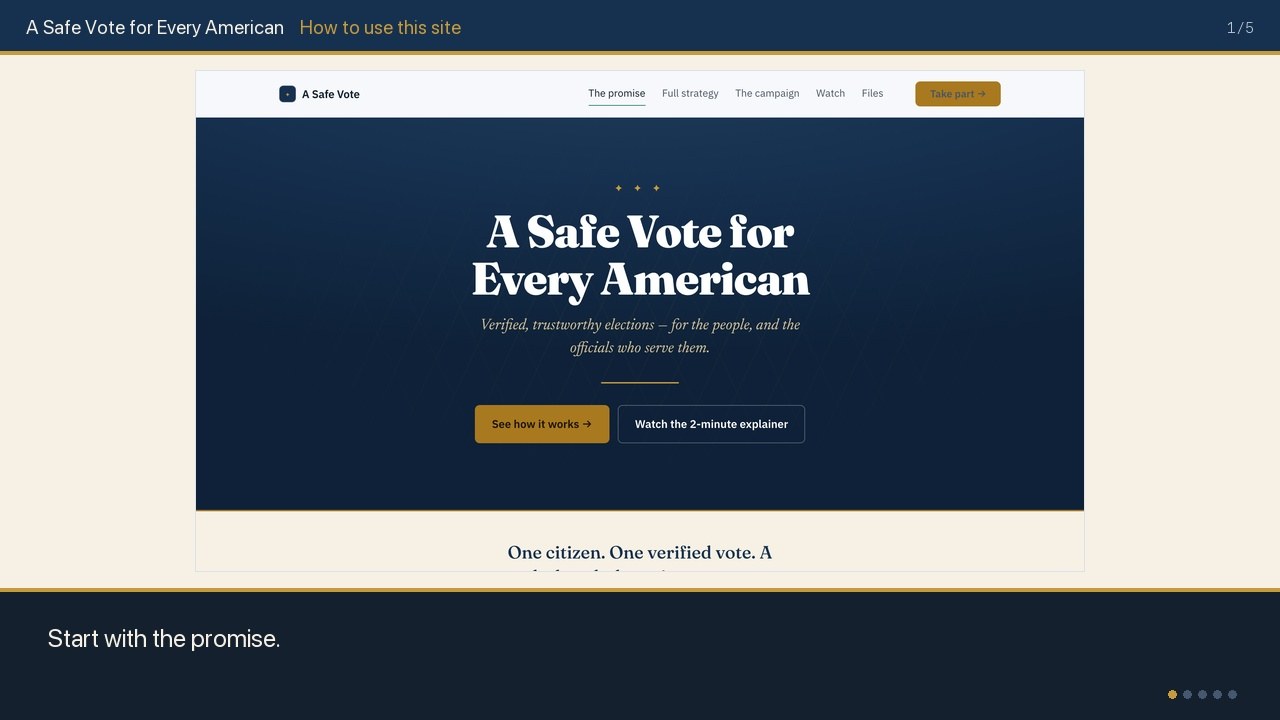
A two-minute tour: the four sections, the full strategy, the campaign ladder, and the files you can hand to someone else.
Three short videos. No jargon. Captions included — and every word is also written out below, so the videos are never the only way to get this.
Either one gets you the whole thing. These are explanations of how the strategy and this site work — not a demonstration of a real election, and nothing shown or described in them is an actual result.
A two-minute tour: the four sections, the full strategy, the campaign ladder, and the files you can hand to someone else.
What actually changes on election day — for a voter, for an election official, and for a candidate who has to concede or claim a result.
A photographic look at the two-minute check — from your own kitchen table, at a verification desk, or with someone helping you. Whatever you need, there is a way through.
Illustrated with licensed stock photography. The people shown are stock photography subjects, not real voters, and no scene depicts a real verification session. Photo credits →
This is the part that matters if you'd rather not watch: the complete narration from all three videos, written out step by step.
Welcome to A Safe Vote for Every American. This site has four parts, and you can read it in any order. Start here, on the front page. It lays out the whole idea in plain language: one citizen, one verified vote, a result the nation can trust, and not one eligible American left behind.
Scroll the front page and you will find four promises made to every voter, and further down, four things the system can never do. Read them together. The limits are as much a part of the design as the promises, and you should hold the system to both.
If you want the complete document, go to Full Strategy. It is the whole plan in seven short parts, with a table of contents down the left side so you can jump straight to the part you care about. It ends with a scope note that tells you honestly what this document is and is not.
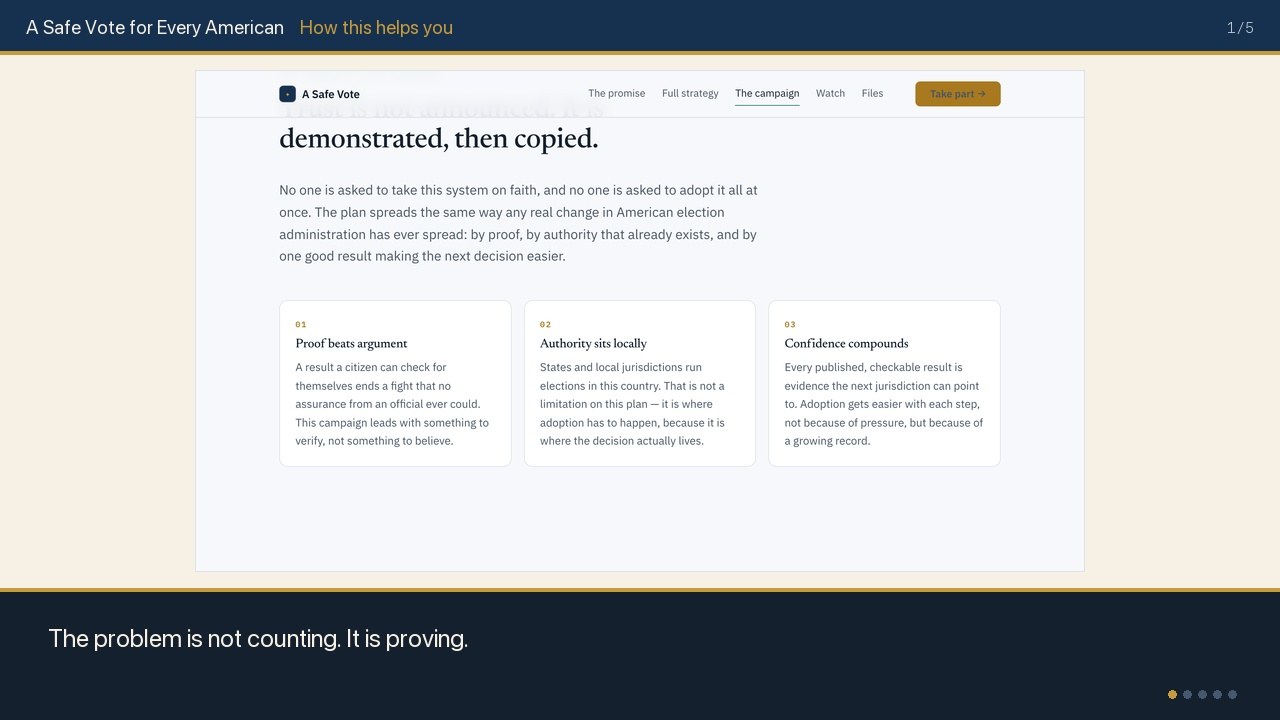
The Campaign page answers the practical question: how does this actually get adopted? It walks up a ladder, from a single organization voting its own election, to a municipality running it alongside paper, to a state, and finally to the federal role, which is to enable and fund, never to mandate. It also answers the hardest objections honestly.
Finally, the Files page. Everything here is yours to print, forward, and hand to an official or a neighbor. The one page version is the one to actually put in someone's hand. And if you want to see a verifiable election working rather than described, the demo is linked from the footer of every page.
Here is the problem this solves. Most election disputes are not really arguments about arithmetic. They are arguments about trust. One side is asked to accept a number it cannot check, from people it does not trust. No amount of reassurance settles that. Only proof does.
If you are a voter, three things change. Your vote cannot be cast twice, because your token is spent the moment you use it. Your vote stays private, because that token carries no identity into the ballot box. And you get a receipt, so you can confirm for yourself that your ballot is in the final count. You are no longer asked to take anyone's word for it.
If you run elections, this hands you something you have never had: a result you can defend without asking anyone to trust you. The paper record still governs. But alongside it sits a published proof that any voter, any candidate, and any reporter can check independently. The burden of proof stops resting on your reputation.
If you are a candidate, you gain the ability to lose cleanly, or to win without a cloud over it. A result that your own observers verified with their own mathematics is not a result you have to litigate in public for a year. And if something genuinely is wrong, the same proof shows it.
One last thing, and it matters most. A system that secured the vote by locking people out would not be safer. It would just be smaller. So every path here is built to be completed by everyone. Video, in person, or assisted, whatever a voter needs. A flag on your record is a to do, never a verdict, and no faulty list ever quietly deletes a name.
Here is the part people worry about most, so let's walk through it slowly. Proving who you are. For most Americans, there is nothing to do at all. If the rolls already know you, your token is issued automatically. No trip, no appointment, no paperwork. You simply go and vote, the way you always have.
And if there is a question, because you moved, or you married, or you are newly registered, or a record just doesn't match, clearing it takes about two minutes. You can do it from your own home, over a video call. A friendly official says hello, confirms you are a real, living person, that you are who you say, and that you belong on the roll where you live. That's it. You shouldn't have to leave your home to prove you're you.
Some people would simply rather do this face to face, and that is a perfectly good reason. There is a verification desk, staffed by a person, and the check is the same two minutes. No smartphone required. No fast internet required. If you would rather look someone in the eye, you can.
And if neither of those works for you, someone comes to you, or someone helps you through it. A grandmother without a smartphone. A rural voter without fast internet. A disabled neighbor the video call didn't work for. Every one of those is a path that has to work, because a system that locked them out would not be a safer election. It would just be a smaller one.
When the check is done, your token switches on, and you vote like everyone else. Remember what a flag actually means. It is a to do, not a judgment about you. It is never a mark against your name, and no faulty list, no automated match against death records or felony records or citizenship records, ever quietly deletes anybody. Real questions get settled with a real person, and you always get a chance to answer.
Each of the others answers a different question — pick the one that fits what you actually want next.
The live demo — cast a sample ballot and check the count yourself, end to end.
Visit →For a state or local official weighing a pilot — proposals and what adoption looks like.
Visit →For anyone asking whether this is technically possible at national scale.
Visit →